Inside an Infrared Survey: Industrial Facility Report
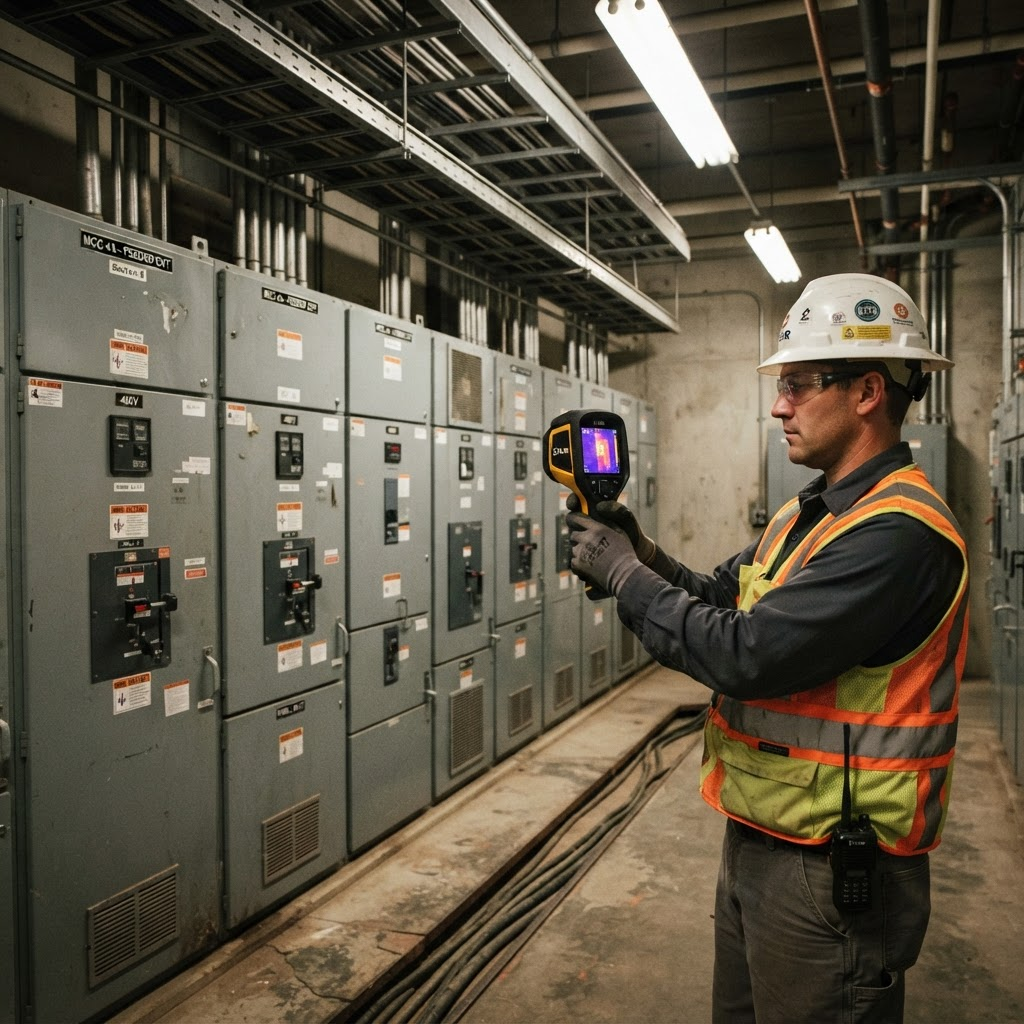
This is an anonymized sample of a real Invizions infrared inspection report for an industrial manufacturing plant. It shows how we scan an entire facility's electrical and mechanical systems, trend results year over year, and document each thermal exception with an objective NETA priority rating and a clear corrective action.
Manufacturing Plant — Huron, OhioJune 2026Level II Certified Thermographer
Report Foreword
Every Invizions report provides complete documentation of the exceptions — abnormally warm or cool equipment — found during the infrared inspection of your equipment. It uses a variety of data and ratings to help prioritize your repairs and give you the greatest return from your maintenance efforts.
Inspections are performed and prepared by a Certified Infrared Thermographer. To earn this certification, the thermographer must complete coursework and pass examinations administered by the Infraspection Institute.
This report fully meets the requirements of the Infraspection Institute's “Guidelines for Infrared Inspection of Electrical and Mechanical Systems.” It also references, incorporates, and exceeds all other published guidelines and standards pertaining to the infrared inspection of electrical and mechanical systems, and is conducted to NETA (National Electrical Testing Association) standards.
Year-Over-Year Trending
This facility is on a recurring annual inspection program. Each asset carries a status history, so developing problems can be spotted as they emerge and verified as repaired. Every one of the 60 monitored assets is logged with a status for each visit — OK (no problem found), EX (exception/potential problem), N/O (not operating), or OFF — building a maintenance record that gets more valuable every year.
2024
Baseline
Initial survey
2025
Re-scan
Trend & verify
2026
This report
6 exceptions
How Findings Are Prioritized
Temperature Severity Ratings are objective and based on temperatures measured by the thermographer. The exception temperature is compared against a reference temperature on a similar healthy component (or against ambient air for operating equipment) to produce a delta-T — the temperature rise — which maps to the NETA Priority Criteria for Electrical & Mechanical Exceptions:
10–18°F rise
Possible deficiency; warrants investigation.
218–36°F rise
Probable deficiency; repair as time permits.
336–72°F rise
Monitor continuously until corrective measures can be accomplished.
472°F & above rise
Major discrepancy; repair immediately.
Inspection Summary
Over a one-day survey, the thermographer scanned switchgear, distribution panels, disconnects, motor control centers, transformers, and operating motors across 60 assets spanning the basement through the fourth floor. Most tested normal (“OK”); six thermal exceptions were identified and documented for corrective action.
60
Assets inspected
6
Exceptions found
1
Day on site
Documented Thermal Exceptions
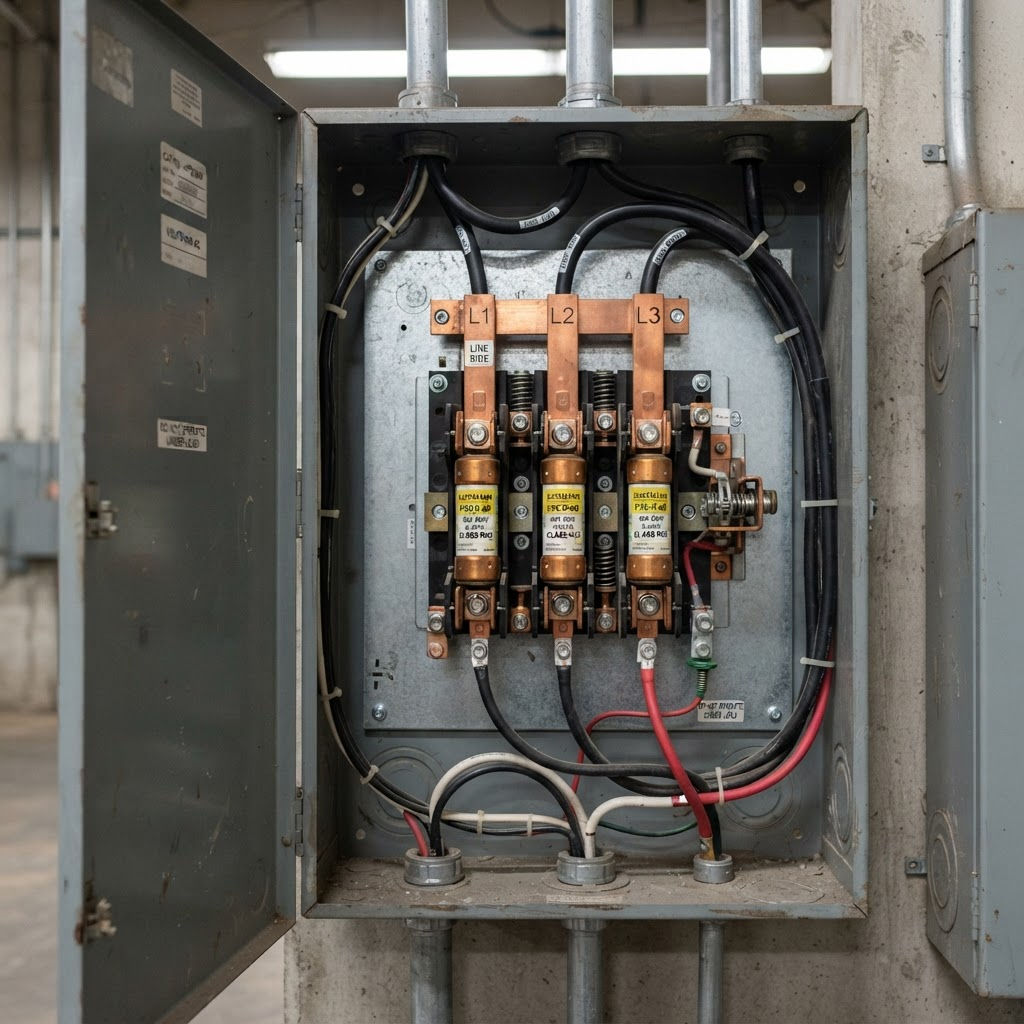
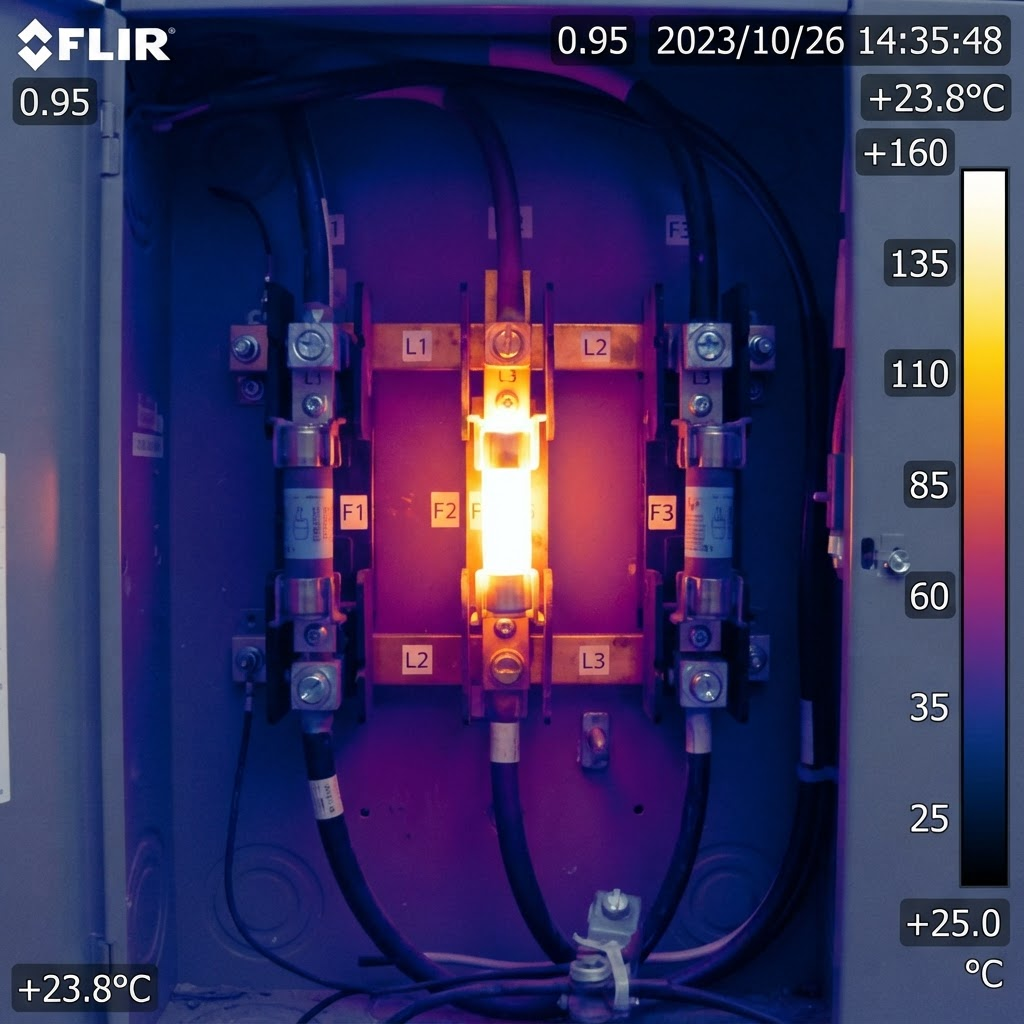
Each exception is documented with a paired visual control photo and thermal infrared image, the measured temperatures, the calculated delta-T, and a specific corrective recommendation.
Representative visual control photoRepresentative thermal infrared image
1
Denora Room — Mezzanine
104B lead/lug connection to terminal block to CB 118 in CP-1 control panel.
Priority 1
Findings
Suspect possible poor lead/lug connection.
Recommendation
Disassemble, inspect, clean and reassemble connection.
NETA Priority Rating
Possible deficiency and warrants investigation.
Exception Temp (Area 1)115°F
Reference Temp (Area 3)99°F
Delta-T16°F
2
2nd Floor
Bottom center fuse clip connection in SS 045 K-6 Feed Pump disconnect panel.
Priority 2
Findings
Suspect possible poor fuse clip connection.
Recommendation
Remove fuse, inspect, clean clip and fuse and check clip for proper tension.
NETA Priority Rating
Indicates probable deficiency; repair as time permits.
Exception Temp (Area 1)127°F
Reference Temp (Area 3)105°F
Delta-T22°F
3
2nd Floor
Top left and top center fuse clip connections to disconnect in SS 106 K-6 Mill control panel.
Priority 3
Findings
Suspect possible poor fuse clip connections.
Recommendation
Remove fuses, inspect, clean clips and fuses and check clips for proper tension.
NETA Priority Rating
Monitor continuously until corrective measures can be accomplished.
Exception Temp (Area 1)175°F
Exception Temp (Area 2)157°F
Reference Temp (Area 3)125°F
Delta-T50°F
4
2nd Floor
Top center lead/lug connection to contactor in SS 106 K-6 Mill control panel.
Priority 2
Findings
Suspect possible poor lead/lug connection.
Recommendation
Disassemble, inspect, clean and reassemble connection.
NETA Priority Rating
Indicates probable deficiency; repair as time permits.
Exception Temp (Area 1)127°F
Reference Temp (Area 3)107°F
Delta-T20°F
5
2nd Floor
K-6 Take Away Pump Motor.
Priority 3
Findings
Suspect motor to be operating near or above rated temperature.
Recommendation
Check motor rating, inspect motor for high operating temperature and correct as required.
NETA Priority Rating
Monitor continuously until corrective measures can be accomplished.
Exception Temp (Area 1)233°F
Ambient Air Temp.85°F
Delta-T148°F
6
3rd Floor
Bottom left fuse clip connection to disconnect in SS 93 K-6 Agitation control panel.
Priority 3
Findings
Suspect possible poor fuse clip connection.
Recommendation
Remove fuse, inspect, clean clip and fuse and check clip for proper tension.
NETA Priority Rating
Monitor continuously until corrective measures can be accomplished.
Exception Temp (Area 1)162°F
Reference Temp (Area 3)123°F
Delta-T39°F
Equipment & Data Log
Certified Thermographer
Level I/II Certified (Infraspection Institute)
Camera Manufacturer
FLIR
Model
T440
Software
FLIR Quick Report 1.2
Accuracy
+/- 2%
Calibration
Annual (02-28-2026)
Wave Band
Long Wave (8–14 µm)
Lens
FOL18
Ambient Air Temp.
85°F
Inspection Type
Industrial Electrical / Mechanical
Want a Report Like This for Your Facility?
Invizions performs infrared surveys of industrial plants, switchgear, motor control centers, and mechanical systems — with clear, NETA-rated documentation and year-over-year trending you can act on.