Substation Partial Discharge / Corona Survey
Find Insulation Failures Before They Take the Line Down
Corona and surface tracking emit ultrasound long before they arc. Using acoustic imaging with PDQ Mode, we locate and classify discharge on live, energized equipment — no shutdown required, no enclosure opened.
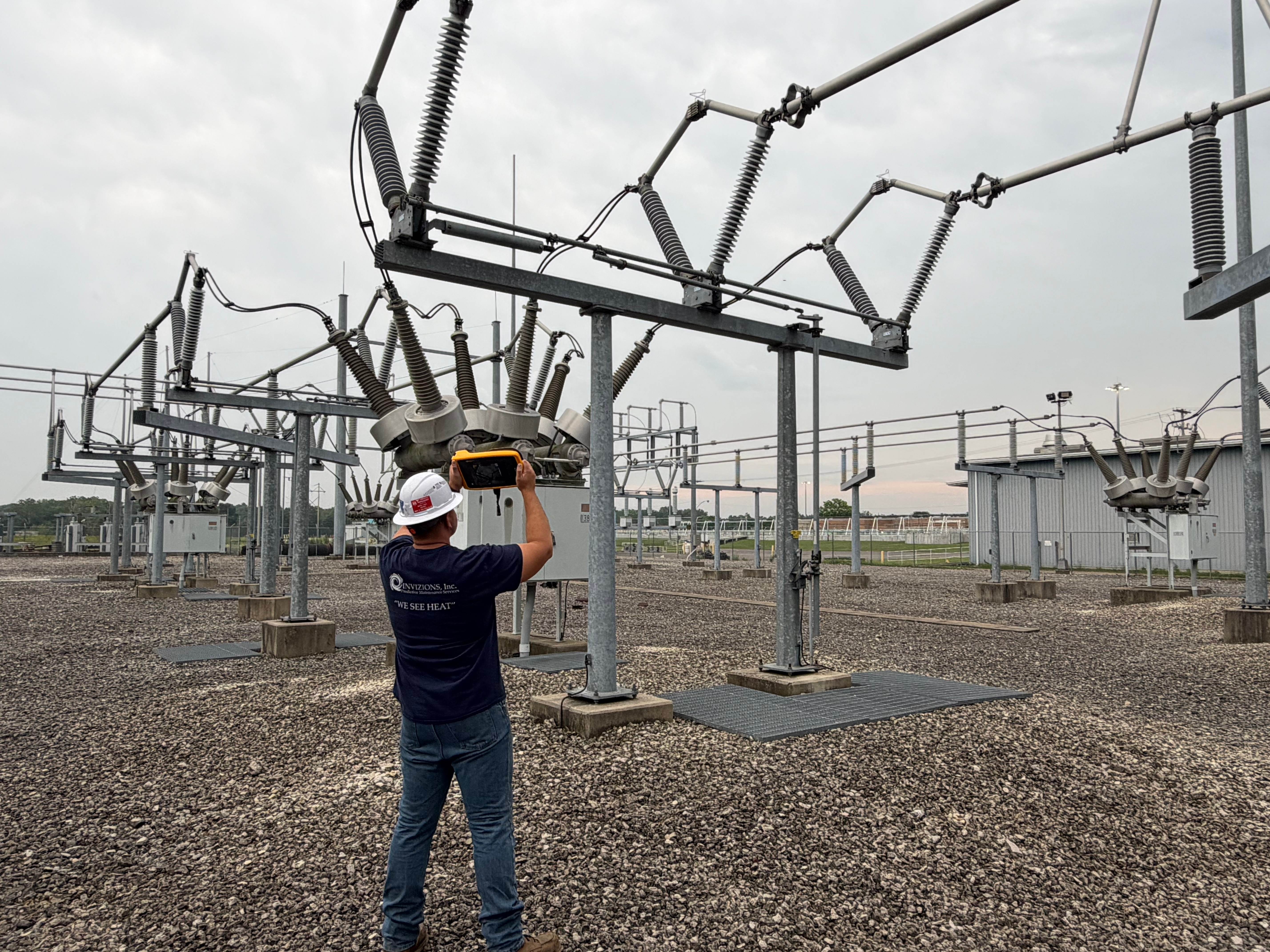
Live 138 kV survey — equipment energized and in service throughout
What Is Partial Discharge?
Partial discharge is a small electrical breakdown that jumps part of the way across an insulation gap without fully bridging it. Instead of tripping a breaker, it quietly chips away at the insulating material — across a dirty insulator surface, inside a void in a bushing, or off a sharp edge into the air.
Each of those tiny discharges releases a burst of ultrasound well above human hearing. That is what makes the condition detectable: the equipment looks and sounds normal, and often runs at a normal temperature, but it is broadcasting a signature that an acoustic imager can see and locate.
Left alone, the damage compounds. What starts as faint tracking on a switch insulator ends as a flashover, a forced outage, and a replacement on someone else's schedule.
Discharge types we classify
- External / Corona
- Ionization of the air around sharp edges, damaged conductors, or loose hardware.
- Surface Tracking
- Carbonized paths forming across contaminated insulator and bushing surfaces — the most common finding in outdoor substations.
- Internal
- Discharge inside voids in solid or cast insulation, hidden from any visual inspection.
Why It Matters
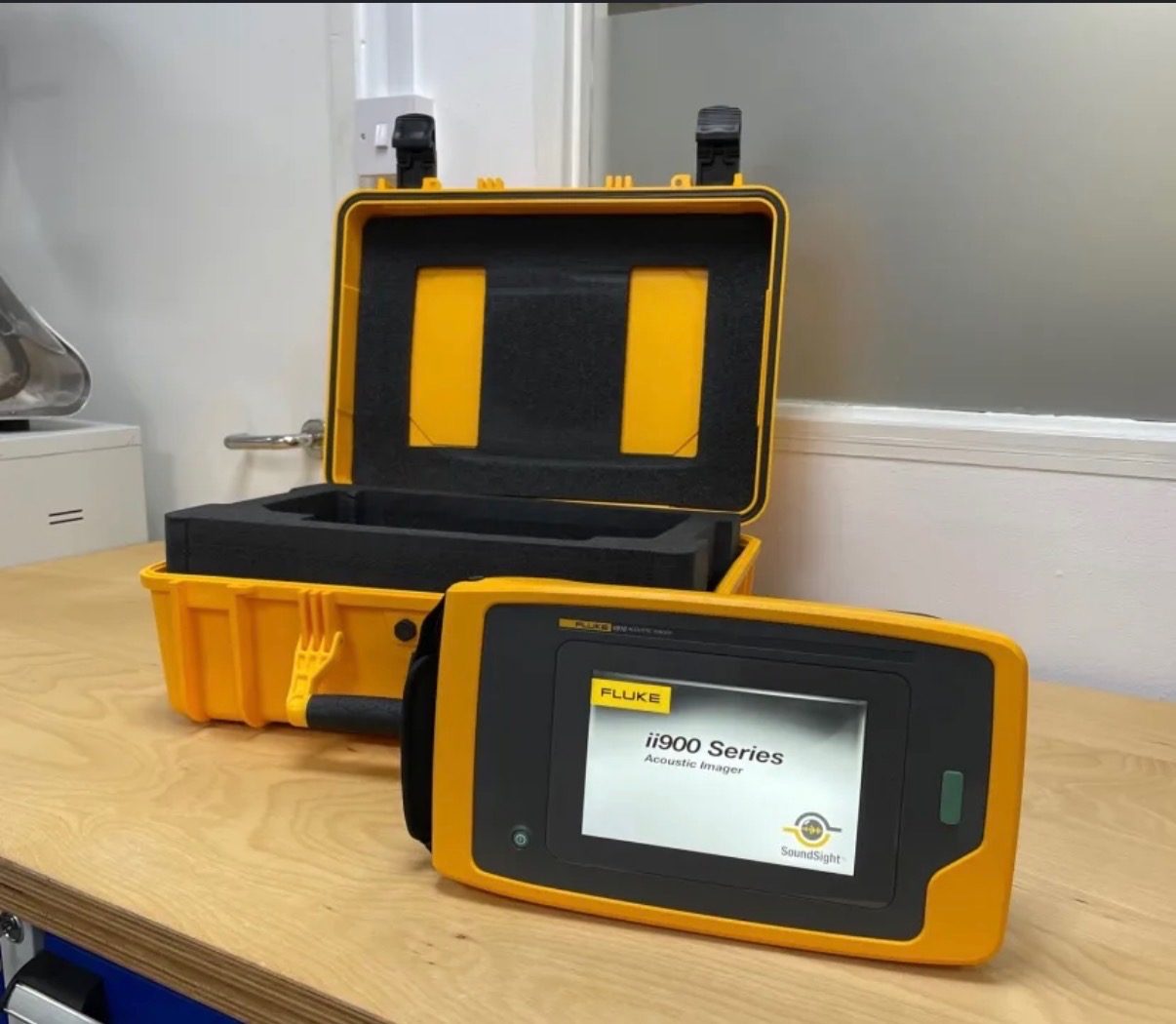
Purpose-built acoustic imaging equipment lets our technicians locate discharge from a safe distance while your substation stays energized
Unplanned Outage Risk
Partial discharge erodes insulation for months before it flashes over. Finding it early turns an emergency callout into a scheduled repair.
Equipment Life Extension
Bushings, insulators, and switches degrade fastest once discharge begins. Correcting it early preserves the remaining service life of the asset.
Arc-Flash Safety
Detection is non-contact and performed from a safe working distance, so nobody opens an energized enclosure to find the problem.
NFPA 70B Compliance
Documented condition assessments of energized equipment support your Electrical Maintenance Program and insurance requirements.
How We Test
The survey happens while your substation stays online. Everything below is performed from ground level or an approved working position, with no contact to energized parts.
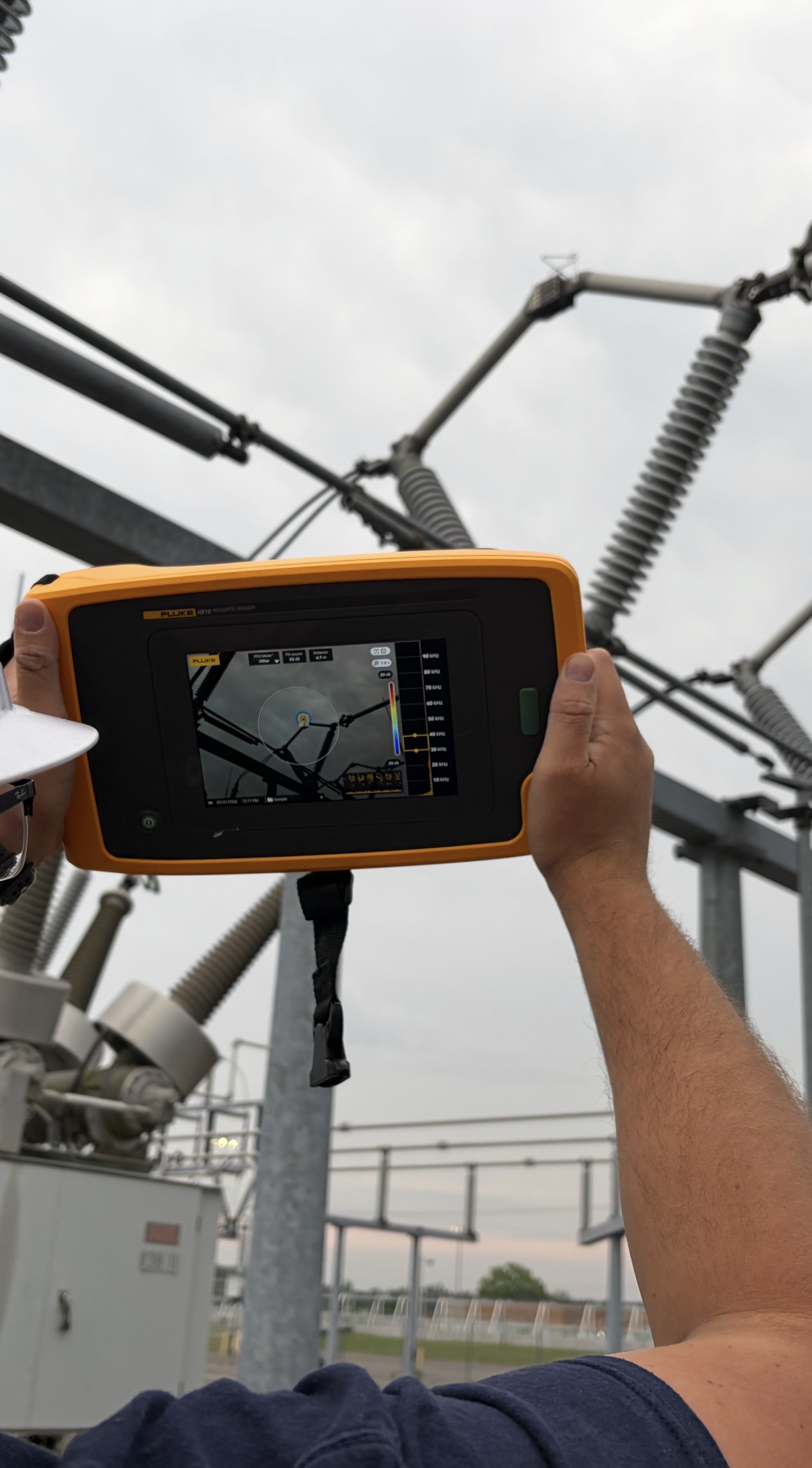
PDQ Mode overlay pinpointing the discharge source on an energized switch.
01
Walk the yard under load
A certified technician surveys the substation with a Fluke ii910 acoustic imager while equipment stays energized and in service. No outage, no de-energization, no production impact.
02
Non-contact detection at a safe distance
The imager localizes ultrasonic emissions visually — overlaying the acoustic source directly on the camera image — so switches, bushings, and bus work are assessed from outside the approach boundary.
03
Capture and classify per asset
For every indication we log pulse count per minute, sound pressure level at the sensor and at the source, distance, operating voltage, ambient temperature and humidity, then classify the discharge type in PDQ Mode.
04
Report with prioritized findings
Each asset is documented with its acoustic image, PRPD plot, and discharge classification, so your crews know exactly what to address and in what order.
Report excerpt
A Sample Finding
Every indication is documented like this — asset data, acoustic capture, discharge classification, and the phase-resolved plot behind the call.
Capture: Sample_260721121242 — 138-2 center switch, north substation
| Asset ID | 138-2 center switch |
|---|---|
| Location | North substation |
| Operating Voltage | 138,000 V |
| Discharge Type | Tracking |
| Pulse Count / Min | 13,709 |
| SPL at Source | 53.22 dB |
| Conditions | 70 °F / 80% RH, overcast |
Discharge type classification
- Tracking
- 54%
- External
- 45%
- Internal
- 0%
- Other
- 1%
What You Get
You receive a written report for each site, prepared and signed by the certified consultant who performed the survey. Every indication is presented with its asset ID and location, the acoustic capture, the measured pulse and sound pressure data, the environmental conditions at the time of the reading, and the PDQ Mode discharge classification with its supporting PRPD plot.
The format is built to be handed straight to the people who need it — your maintenance crews, your insurance carrier, and your regulator — as documented evidence of a condition assessment performed on energized equipment.
Every report includes
- Per-asset findings with asset ID, location, and operating voltage
- Pulse count per minute and sound pressure level at sensor and source
- Ambient temperature, humidity, and weather conditions at capture
- PDQ Mode discharge type classification percentages
- Phase-resolved partial discharge (PRPD) plot per indication
- Certified technician sign-off and equipment used
25+
Years in predictive maintenance
Level III
Certified thermography staff
Fluke ii910
Acoustic imaging platform
3
Core sectors: utilities, manufacturing, data centers
Ready to find problems before they find you?
Tell us about your substation and we will scope a partial discharge survey around your operating schedule — no outage required.
Invizions, Inc. — 2519 State Route 61 South, Norwalk, Ohio 44857 · Office 419.663.8621